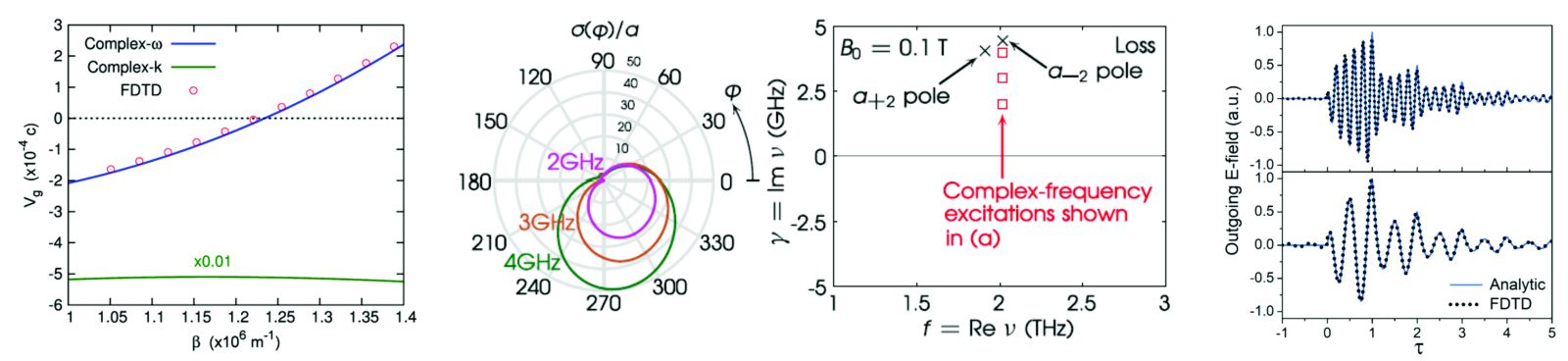
Complex-frequency excitations [1–4] have recently been exploited for a range of unexpected and exciting applications in photonics, from compensating losses in metamaterials, superlenses and polaritonic propagation, to enabling virtual absorption, virtual critical coupling, virtual optical pulling forces, virtual parity-time symmetry, and diverse other functionalities beyond the usual bounds on light scattering. These excitations open a new perspective to the optical world, primarily because they can make a lossy (e.g., plasmonic) structure behave as if it was completely lossless (while still plasmonic, i.e., with Re{ε} < 0) – without any violation of the conservation of energy (the whole phenomenon turns out to be a delicate, dispersive interference effect).
We were the first group (back in 2011) to show how these solutions can be excited in the time domain (of relevance to realistic experimental setups) [1-3], and more recently we proposed the first fully-analytic closed-form time-domain description of these excitations in the context of attaining ‘virtual absorption,’ capturing all the involved dynamics [4]. We have also recently introduced the concepts of anisotropic virtual gain and oblique Kerker effect [5], where a lossy anisotropic medium behaves exactly as its anisotropic gain counterpart upon excitation by a synthetic complex-frequency wave. That strategy allowed one to largely tune the magnitude and angle of a particle’s scattering simply by changing the shape (envelope) of the incoming radiation, rather than by an involved medium- tuning mechanism. The so-attained anisotropic virtual gain enabled directional super-scattering at an oblique direction with fine-management of the scattering angle. We are currently exploring further consequences of and phenomena arising from these fascinating excitations. Our monograph on ‘Metamaterials and Nanophotonics’ [6] is the first book to delineate and analyze them.